Managing various types of coolers under Linux has never looked sleeker! The latest CoolerControl v5.0.0 release is out now.
What exactly is it? CoolerControl is an open-source application for monitoring and controlling supported cooling devices on Linux. It features a system daemon with a built-in Web UI, an optional desktop app, and a
comprehensive REST API.
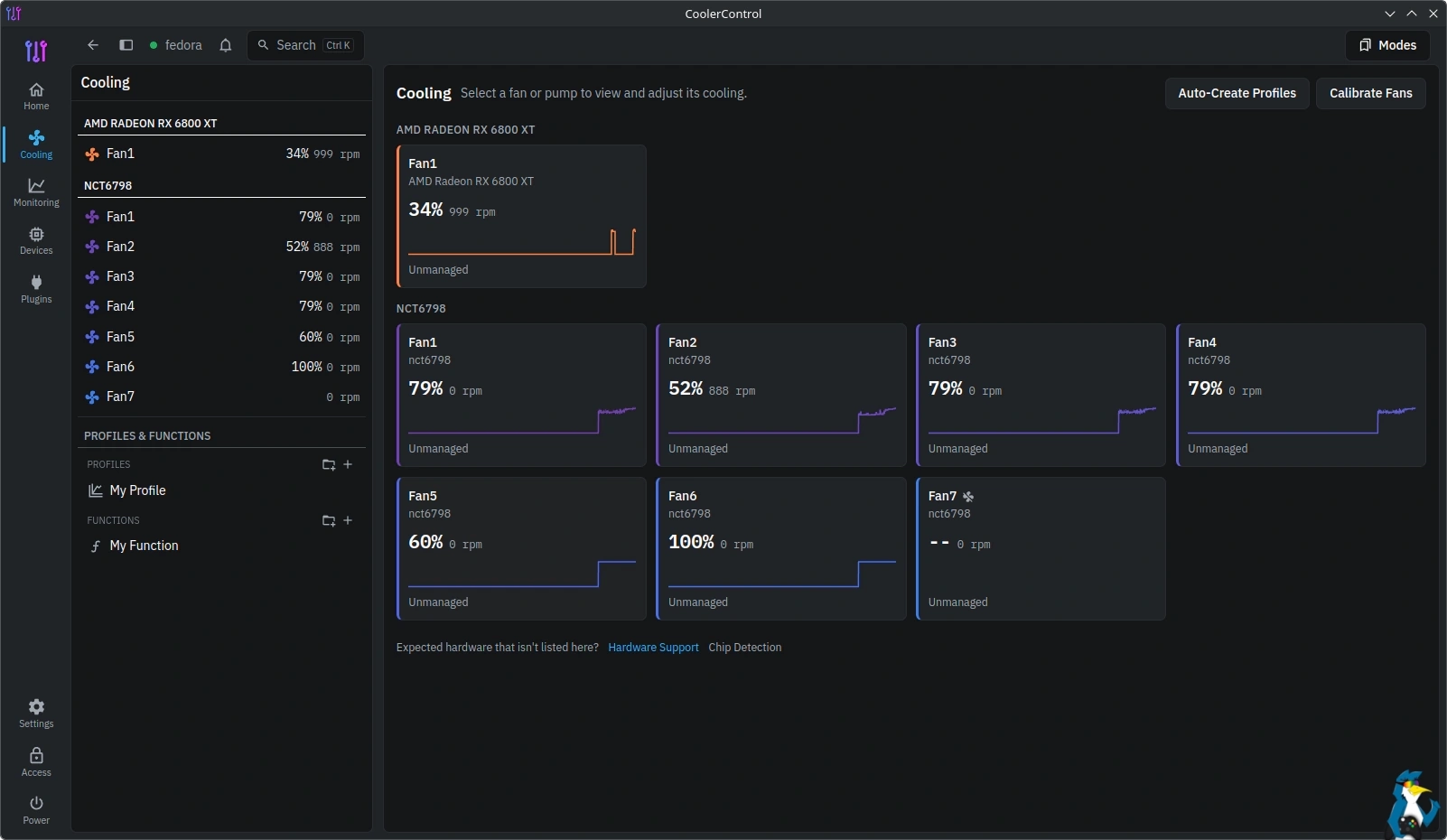
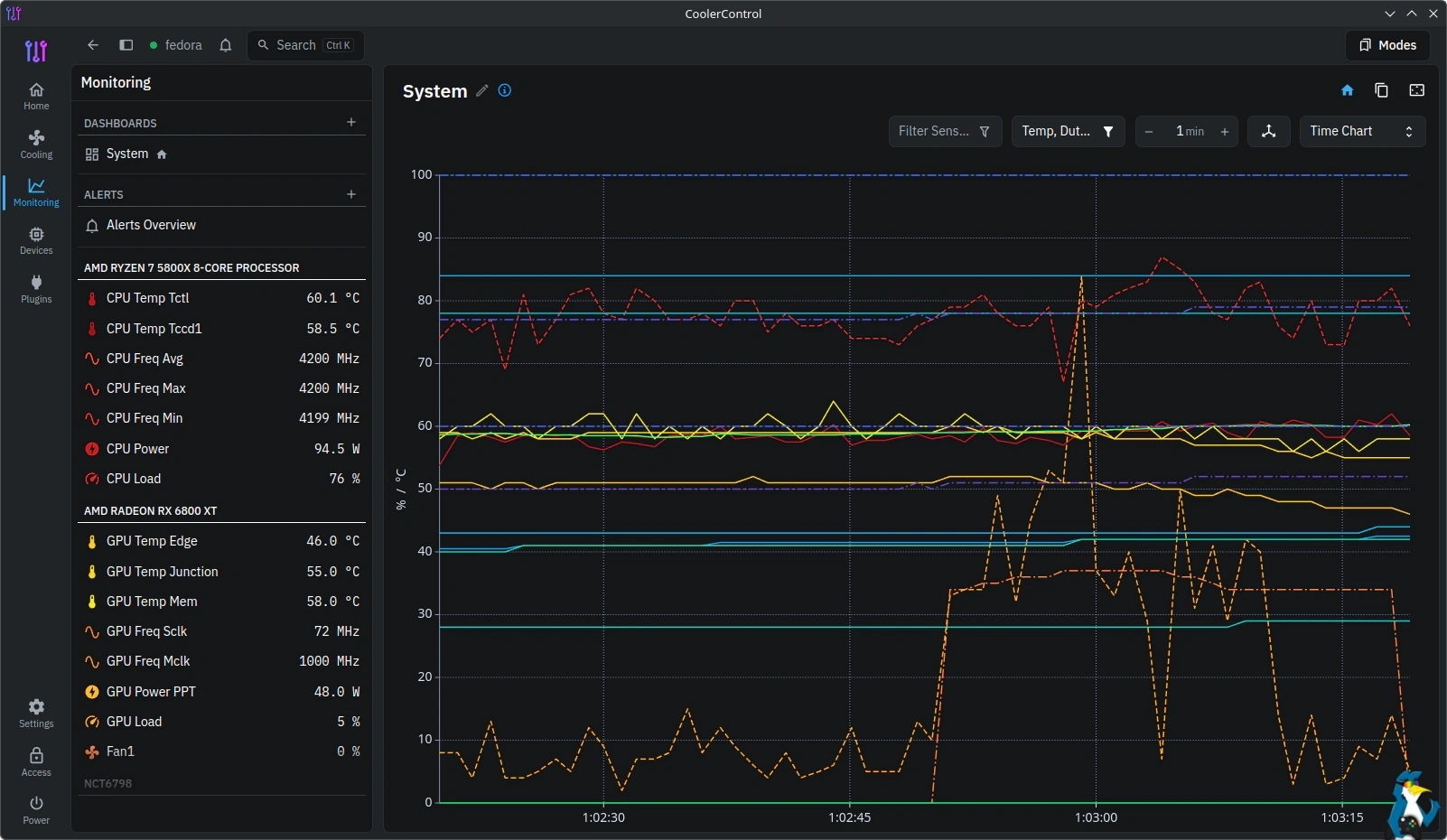
In the 5.0.0 release that just arrived it includes a fully rebuilt UI, along with a new auto-creation profile wizard to help you deal with all the ins and outs of it. This should make the app a whole lot more approachable overall.
The full changelog is rather long, filled with all sorts of new features and tweaks to make it easier to use and better looking than ever.
Added
- Rebuilt application UI shell: Home, Cooling, Monitoring, Devices, Plugins and Settings sections, with a persistent icon rail, per-section side panels, and landing pages for each area.
- Mobile layout with bottom navigation, a header overflow menu for the Access, Power and Plugins menus, a dashboard switcher, and responsive editors throughout.
- Consolidated channel page in the Cooling section: embedded profile editor, mini curve previews, grouped manual duty control with a sized gauge, and per-channel setup menus.
- Expandable control-flow tree on channel pages, drawn with CSS instead of a chart library, with links from each chain pill to its editor and persisted open state.
- Auto-Create Profiles wizard that generates cooling entities for CPU coolers, GPU fans, AIO pumps and radiators, case fans and laptops, driven by editable tuning data compiled into the daemon.
- Calibration wizard with a batch API, per-fan warnings surfaced in the picker and completion log, resume support, and abort on an active alert.
- Calibration understands firmware fan curves: firmware-controlled fans are flagged in the picker, their curves are mapped through calibration, and sweeps skip the clamped duty band.
- Calibration state and firmware-curve status are shown on cooling channel cards, with the curve dialog acting as the calibration hub.
- A calibrated fan’s settings can be converted to true duty from its channel page, backed by a new daemon duty-map endpoint, asking for confirmation before forking a shared profile and showing fork and sharing state on every channel.
- Progress bars in the calibration wizard.
- Device health tracking: a daemon-side registry of failsafed channels and missing or stale temp sources, surfaced as menu badges, a health panel, entity-page warnings, and a Home status dot, split into permanently unsupported and currently degraded sections.
- Hardware Support card on Home, separate from device health: what the startup detection found, why a given fan channel cannot be controlled, and a paste-ready hardware report that can be previewed in-app and copied as a code block for bug reports.
- Saved daemon connections in the desktop app: a managed list in the connection wizard, a tray submenu to switch daemons, and per-connection access tokens and pinned sensors.
- TLS certificate pinning and validation in the desktop app, with a prompt to trust an unknown daemon certificate and a manager for the ones already trusted.
- Pinned sensor readings in the tray menu, colored to match the UI and clickable to open their page, grouped into a submenu when many are pinned.
- The desktop app asks once, the first time closing its window would send it to the tray instead of quitting.
- The desktop app’s connection wizard shows the last connection error, so a stopped service, a wrong port and a refused certificate are told apart.
- The desktop app’s tray, connection wizard and dialogs are now translated, using strings pushed from the UI.
- A single multiplexed
GET /sseendpoint carrying every event kind on one connection, with aneventsfilter to narrow the subscription; the UI and the desktop app each use one stream now. - User-defined device and channel names are now daemon-owned in a hand-editable
overrides.toml, editable from any entity page, with detected-name hints and a one-time migration fromconfig-ui.json. - lm-sensors
sensors.confsupport: applies its labels and honorsignorefor hwmon channels (#334). - Installed color themes: True Black, Dracula, Gruvbox, One, Catppuccin, Tokyo Night, Monokai, Nord, Solarized, Hackerman and Solitude, in light and dark variants where the palette has both, chosen from a preview dropdown with color swatches.
- The System theme follows the desktop’s own colors in the desktop app, as far as the desktop exposes them: the full palette on KDE, otherwise the accent color and light or dark preference from the XDG desktop portal, and the built-in light and dark themes when neither is available. The settings preview shows whichever of those will land.
- Custom themes gained success, warning, error and info colors, carried by a new
cct2:theme code. - Multi-source alerts with per-source state, timed silencing with notify-on-expiry, and a per-alert log table on each alert page.
- Alert indicator in the top bar, silenced and disabled glyphs in the menus, and tray badge state pushed to the Qt app over IPC.
- Tags on channel rows as interactive chips, with a tag filter bar and a tag manager.
- Modes management with apply wizards, where-used listings, and a previous-mode indicator.
- “Used by” links and type icons across profiles, functions, channels and sensors.
- Folders in the Cooling panel’s Profiles & Functions library: add, rename and delete folders, and drag profiles and functions in and out of them. The same grouping is carried into every profile and function picker, so a picker reads like the panel.
- Rows in the Modes table link to the page of the channel they set, picking the cooling, lighting or LCD editor by what the channel controls.
- Backup CLI: archive, restore, list, rotated backup and config-check subcommands.
- Bulk device and sensor enable/disable editor.
- Target versus actual duty in the Mix profile editor.
- Actual fan duty drawn alongside the curve on Graph profile charts, live duty lines on the profile overlay chart, and a points-table corner remembered per profile.
- A reconnecting screen when the daemon connection drops, with the wait scaled to the poll rate and a desktop-app notification once the daemon has been unreachable for ten seconds.
- Channels remember the profile they last ran, and offer it back after a spell at a fixed speed.
- Temperature and power readings shown during stress tests.
- Per-channel failsafes for service plugin devices.
- Section hotkeys, a configurable startup page, and a menu collapse button in the header.
- Interface font setting, with IBM Plex bundled and a numeric face used for live values.
- Live chart on the custom sensor page.
- Reworked product tour, replayed once for everyone.
- Daemon settings grouped into subsections, with a range unlock for guarded values and a startup delay that now reaches 120 seconds.
- Hotspot temperature for NVIDIA Blackwell (RTX 50xx) cards, read from an NVAPI register.
- Firmware-reclaimed fan control is detected and re-asserted, so a fan taken back by the board firmware returns to CoolerControl.
- The web UI can be installed as an app from the browser, carrying a web app manifest and icons; an installed window gets the in-app back button that the desktop app already has.
- Debian and Ubuntu packages are published to
apt.coolercontrol.org, including Ubuntu arm64 builds. - The daemon reports readiness and liveness to systemd, so a wedged main loop is restarted by the systemd watchdog.
- Global search over pages, entities, settings and actions, with recent results.
- System power profiles can be mapped to Modes, so switching the desktop’s power profile switches the cooling Mode.
- Cooling and Devices pages help explain missing and uncontrollable fans, with help lines that link to the hardware report.
- Help icons across the UI now come from one shared component, and renameable titles are marked with an edit icon.
- A failed fan write on a ThinkPad hints at enabling ThinkPad fan control, and the enabled state is reflected without a daemon restart.
- Plugin UIs receive the whole theme palette, so plugin pages match the active theme.
- liqctld reports LCD frames that outgrow their bucket, and gif upload is hidden on firmware that refuses it.
Changed
- The daemon now runs on the compio runtime with io_uring by default, with a small tokio sidecar for dependencies that require it;
--no-default-featuresstill builds the tokio-only path. - PrimeVue was replaced by an in-house component kit built on reka-ui, covering dialogs, toasts, tooltips, dropdowns, selects, tables, inputs and confirms.
- Toasts are capped, hover-pausable and copyable; dialogs, dropdowns and popovers share consistent offsets, shadows and stacking.
- Fan channels now resolve to one canonical page regardless of where they are opened from.
- Log output is bounded and de-duplicated: capped log buffers, an episode gate for repeated device errors, and coalesced SSE bursts.
- Device UIDs are guarded against duplicates, so two identical devices no longer collapse into one.
- Names are resolved once in the daemon and used consistently in logs, alerts and failsafe messages.
- Settings moved from tabs to an anchored card grid.
- Info and Tools was dissolved into the Home section.
- Alert thresholds accept fan speeds up to 30000 RPM.
- Warning and success colors darken on light themes to stay legible, and status colors are now checked for contrast in the test suite.
- The desktop app authenticates with its own bearer token per connection instead of a shared session, and discards the web renderer while it sits in the tray.
- The per-stream
/sse/{logs,status,modes,alerts,notifications}routes are deprecated in favour ofGET /sse, and are scheduled for removal in 5.2.0. - AMD GPU fan curves are no longer reset before every apply, and unusable curves are rejected rather than written.
- Idle liqctld connections are reaped, and NVML is released when all GPUs are disabled or none are detected.
- NVAPI thermal lookups and PCI bus lookups are cached.
- LCD frames are packed in C and sent in a single transfer, the per-apply re-initialize was dropped, and single-temp images are rendered off the async runtime, so an LCD update costs far less.
- Sysfs descriptors are held across ticks, sysfs values are read without heap allocation, and Time Average and EMA custom sensors keep a cached sample window, lowering per-tick overhead.
- liqctld reports each LCD’s model, device path and framebuffer packing, and logs why a frame skips the rotation.
- Live chart animation is throttled and paused off-screen.
- The Makefiles were split and documented behind
make help. - protoc is no longer a build dependency; protox generates the gRPC code.
- The minimum supported Rust version is 1.88.
- License headers were converted to SPDX short-form, an AUTHORS file was added, and REUSE compliance is checked in CI.
- The OpenAPI specification is generated offline, pretty-printed, and refreshed on every version bump.
- Many upstream dependencies updated across Cargo and npm, and derive_more, axum-typed-multipart and zstd compression were dropped.
- Application icons were redrawn from generated sources: a symbolic tray icon sized to sit with its peers, notification icons matching the app stroke, and an alert badge that stays error-red on symbolic hosts.
- The logo and fonts are bundled so they are content-hashed, and unhashed assets are revalidated rather than pinned, so a browser picks up a new UI build.
- The Kraken 2023 firmware 2 LCD frame is sent once per update instead of twice, and LCD images are capped at liquidctl’s gif size limit.
- Modals dim with opacity instead of a backdrop blur, which flickered on some GPU and QtWebEngine combinations.
- Plugin services are restarted rather than replaced on a configuration change, and a service is installed when its plugin is enabled.
- Plugins running under OpenRC require OpenRC 0.45 or newer.
- Access tokens are validated against a SHA-256 digest instead of argon2, so an authenticated request no longer pays a password hash on every call; the argon2 hash is still written for backward compatibility.
Fixed
- liqctld could be orphaned during a liquidctl error storm, and now exits promptly on shutdown.
- Blank device UIDs on some systems (#594 (closed)).
- RDNA3/4 AMD GPUs went undetected when the kernel overdrive mask was off (#589 (closed)).
- Calibration now enters manual control mode before measuring (#583 (closed)).
- Older AMD GPUs without hwmon load sensors report load from DRM fdinfo (#562 (closed)).
- GPU stress tests now run off the async runtime and are judged by power draw, fixing newer cards.
- Settings are skipped for channels a device no longer offers, instead of erroring.
- Generated curve floors are clamped to the channel minimum so a low floor cannot stall a fan.
- Kraken LCD writes could take a stale HID report as their answer, which surfaced as missing messages and bucket-switch errors while an image was uploading.
- Single-temp LCD images were rendered to one shared file, so two LCD channels could tear each other’s image or display the wrong sensor.
- Deleting a child custom sensor stripped its parent’s other sources.
- Calibration trusts a fan’s RPM over a sub-floor stall reading, derives the sustain floor across misaligned sweeps, and corrects the inverse duty map’s boundaries.
- Duplicate device UIDs no longer drop devices from AMD and liquidctl repositories.
- Name overrides survive a save error instead of losing the cascade.
- REST and gRPC server startup are decoupled, so one failing does not block the other.
- Chart axis titles no longer overlap the neighbouring axis, and the temp line is clamped to range.
- Charts and their observers are torn down when a page unmounts, which was the main source of memory growth in the desktop app over long sessions.
- AMD zero-RPM support is detected by reading the firmware setting rather than guessing, a failed curve apply is aborted instead of half-written, and an EIO now says what caused it.
- The desktop app no longer loops on reconnect notifications, applies certificate validation without a restart, and raises its window when tray-mode authentication fails.
- The desktop app keeps only one daemon health probe in flight and restarts its connection loop when the event stream answers 401, instead of sitting on a dead session.
- Korean locale detection, translations synced across all supported locales, and translations that had drifted from the English source refreshed.
- Disabled IP family is logged at info instead of warning.
- FIFO pairing could wedge the test suite, and sysfs read tests handle ENODATA.
- SATA drive UIDs are derived from stable hardware identity, WWID first and then serial, with existing settings copied forward, so a drive keeps its settings across reboots and reconnects (#599 (closed)).
- Drive power state is also read through SAT passthrough, so a sleeping drive is not woken to be measured.
- A transient read failure on a File custom sensor no longer drops the sensor.
- Each LCD channel renders to its own image file, shutdown settings whose image is gone are dropped, and the stock image is used when a configured shutdown image cannot be read.
- Alerts re-evaluate when a source is removed, an edit that clears an alert notifies, an announced Error survives an edit, messages name the sensor that left the watch list and use resolved channel labels, the alert count follows silence expiry, and Error alerts are listed on Home.
- Off-scheme colors and tag severities are drawn from the themed tokens.
- The search field keeps a focus ring only for keyboard users and drops it after taking a result.
- The Qt tray alert icon keeps its
-symbolicsuffix and falls back to the pre-rename name. - The application SVG opens within gdk-pixbuf’s 256-byte sniff window, so more icon loaders render it.
- A Standard Function with a maximum step size advanced only one step every 30 seconds once the temperature went flat, because the step limiter stopped running and the safety latch was left to move the fan. The limiter now carries the ramp through to its target, including the last step to 0% or 100% when “Always apply 0% / 100%” is enabled, and the Threshold Hopping tooltip says that the maximum step size is always respected (#602 (closed)).
- Malformed HTTP Basic credentials are rejected instead of panicking the request.
- Repeated daemon warnings are reported once per outage rather than every tick.
Removed
- The EMA Function type. Existing configurations are permanently converted to Identity on load; use an EMA Custom Sensor for temperature smoothing.
- JSON theme file import and export. Theme codes are now the way to share a custom theme.
- The legacy shell and Control views, and the per-device Settings tab.
- PrimeVue, element-plus, vue-flow and radix-vue dependencies.
- The
notifysubcommand, and the unusedcolorsfield from the LCD settings enum. - The gRPC server reflection service, and its build dependency.
Security
- Device and channel name overrides reject injection-capable characters.
- Sensor and channel labels are escaped in the chart tooltip, which is built as markup.
- The desktop app pins and validates the daemon’s TLS certificate and confines its web engine to the daemon it is connected to.
- The desktop app’s settings file is owner-only, and superseded access tokens are deleted.
- npm dependency install scripts are denied during the UI build.
- Backup archives are created owner-only, bounded on extraction, and restore only files listed in the manifest; restored credentials are written owner-only.
- Dependencies updated to clear audit advisories.
- Plugin services run with new privileges denied, and plugin folder ownership is hardened.
- Failed authentication attempts are throttled per client address.
🌐 External Sources: gitlab.com