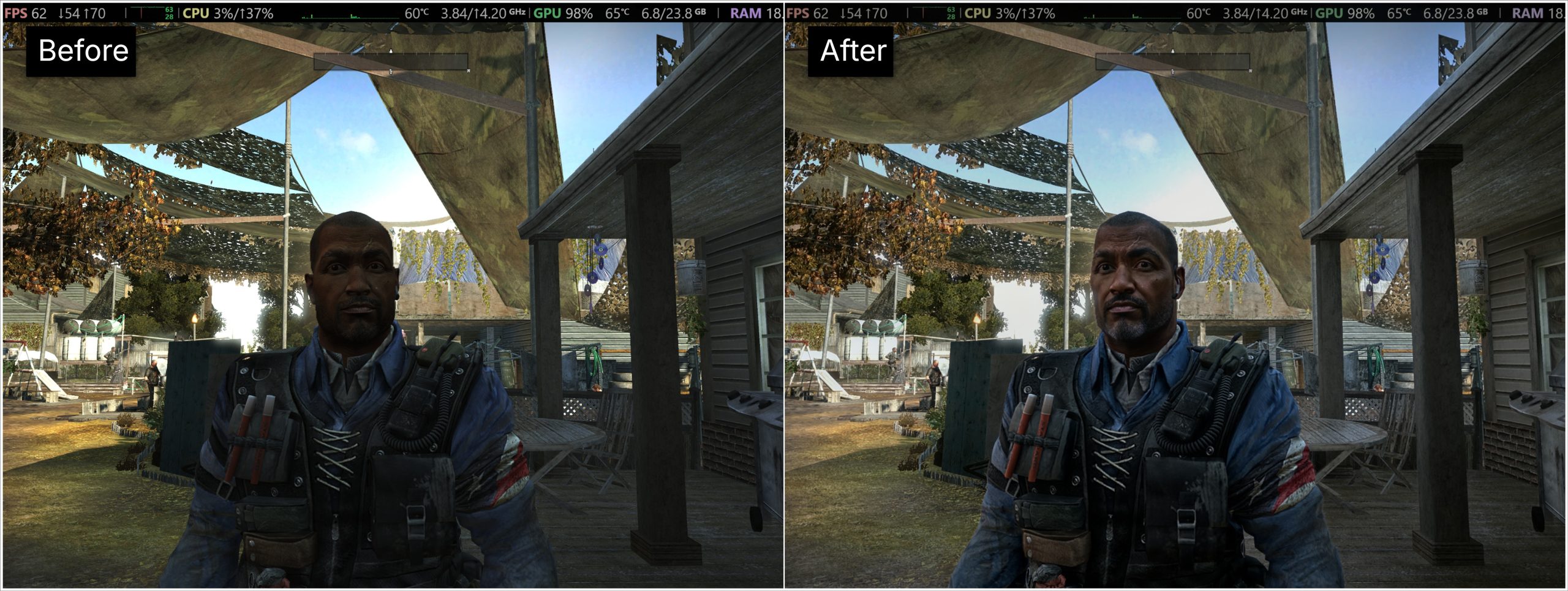
The popular Borderless Gaming Steam app has been updated with two major features over the last week: Frame Generation and DLSS 5 Neural Rendering.
The Frame Generation feature works on a custom general purpose implementation that, according to author Andrew Sampson (also known as the creator of the streaming technology Rainway), was trained on “tens of thousands of hours of gameplay” and requires no game modification to work. As for DLSS 5 NR, like FG, it relies on BGFX, a mode introduced earlier this year that captures game windows at the compositor level and processes them through a GPU effect pipeline, enabling the addition of various effects.
Andrew’s pitch for the DLSS 5 effect is that it sidesteps nearly everything the existing injection tools require. There’s no need to replace game DLLs, modify game files, or hunt down a game-specific mod: you install the effect, select the preset, and apply it to whatever you’re playing.
What makes that possible is that the effect doesn’t call NVIDIA’s software at all. According to Sampson, he spent a lot of time quantizing the model, reworking how it runs, and removing bottlenecks inside its neural network so that it could run on a much wider range of GPUs than just NVIDIA’s latest GeForce RTX graphics cards. Borderless Gaming runs the model directly through BGFX, rather than forwarding requests to NVIDIA’s DLLs.
That’s a notable difference from the tools I used in my recent test of DLSS 5 in The Witcher 3: Wild Hunt – Remastered, which inject the leaked DLL into the game itself. It also sets the effect apart from NVIDIA’s own implementation, which officially supports only RTX 50 series GPUs. By contrast, Sampson says even an RTX 3090 can target around 30 FPS with the Borderless Gaming version, depending on the game and settings.
The update also prompted some confusion about what Borderless Gaming actually ships, though Sampson quickly set the record straight. According to him, the DLSS 5 effect isn’t included in the update, isn’t enabled on a user’s computer by default, doesn’t run in the background, and therefore doesn’t use any resources unless you choose to install it.

The effect is instead a single shader file hosted on GitHub, which uses Borderless Gaming’s existing BGFX scaling system. The app’s update added a way to install effects and presets straight from GitHub by pasting a repository URL, which is how the DLSS 5 shader gets onto your system if you want it. The process is fairly simple:
- Open the effects editor in Borderless Gaming or the presets screen in Holo.
- Choose Install from GitHub and paste the repository’s URL.
- Select the DLSS5-NR preset and enable effects. On Windows, use Scaling (GPU).
Once installed, the effect exposes adjustable strength, lighting, structure, style, and processing resolution. That’s a far cry from the treasure trove of tweakable parameters found in the DLSS 5 tools I described in the aforementioned The Witcher 3: Wild Hunt – Remastered test; however, Borderless Gaming’s implementation certainly has the advantage of simplicity.
Of course, given Sampson’s claims about reworking the model itself, it would perhaps be best described as DLSS 5-derived, rather than NVIDIA’s actual 3D-Guided Neural Rendering, especially since it processes frames captured at the compositor level. Still, despite the social media controversy surrounding NVIDIA’s latest technology, the fervent effort to implement it in games and non-games across various tools and applications speaks to its allure. DLSS 5 is still obviously early and could certainly use some improvements, but it is also clearly groundbreaking.

About the author: With over two decades of experience in gaming journalism, Alessio Palumbo has led the gaming vertical at Wccftech since August 2015. He started working at a young age for Italian websites like Everyeye.it, Gamestar.it, Nextgame.it, and Multiplayer.it before kickstarting the indie English-language publication Worlds Factory as its founder and Editor in Chief.
In the last decade, he has coordinated the overall output of Wccftech’s gaming section, managed PR relations, assigned reviews, produced daily news coverage, edited gaming content as needed, and delivered game reviews.
Arguably, his trademark content is the long series of exclusive developer interviews that have been cited by Wikipedia and by the biggest news media and gaming publications.
His passion for technology also makes him knowledgeable when it comes to gaming hardware and tech. His favorite genres include RPGs, MMORPGs, and action/adventure games.
Follow Wccftech on Google to get more of our news coverage in your feeds.